.png)
In Forex trading, understanding trend momentum is essential for maximizing profits and minimizing risks. Trend momentum refers to the strength and speed of a price movement in a particular direction. By analyzing momentum, traders can identify whether a trend is likely to continue, weaken, or reverse, allowing for more precise entry and exit strategies.
What is Trend Momentum?
Trend momentum is the measure of how strongly price is moving in a particular direction. Unlike simply identifying the trend direction, momentum focuses on the speed and intensity of price movements.
- Strong Momentum: Indicates a robust trend with high probability of continuation.
- Weak Momentum: Signals potential exhaustion or slowing trend, possibly preceding a reversal or consolidation.
Momentum helps traders distinguish between mere price fluctuations and genuine trend movements.
Key Indicators to Measure Trend Momentum
Several technical indicators can help traders measure trend momentum in Forex markets:
- Relative Strength Index (RSI):
- Measures overbought and oversold conditions.
- RSI above 70 may indicate strong bullish momentum, while below 30 may indicate strong bearish momentum.
- Moving Average Convergence Divergence (MACD):
- Combines trend and momentum analysis.
- The MACD line crossing above the signal line signals increasing bullish momentum, and vice versa.
- Average Directional Index (ADX):
- Measures trend strength rather than direction.
- ADX above 25 indicates a strong trend, while below 20 indicates a weak trend or range-bound market.
- Momentum Oscillator:
- Compares current price with previous prices to gauge the speed of movement.
- Rising oscillator indicates strengthening trend; falling oscillator signals weakening trend.
Why Trend Momentum Matters in Forex
- Confirming Trend Continuation:
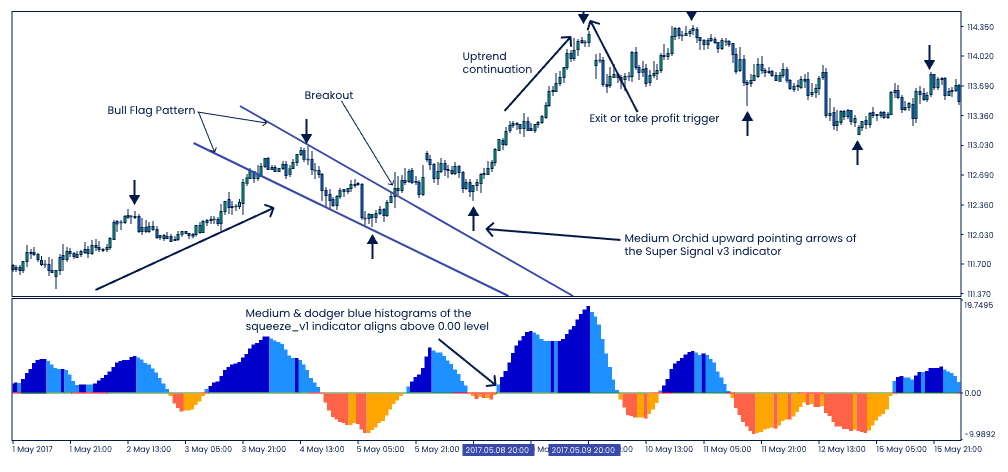
- Momentum analysis helps verify whether a trend is likely to continue before entering a trade. For example, entering a buy trade in an uptrend with strong momentum reduces the risk of a false breakout.
- Timing Entries and Exits:
- High momentum provides confidence for entering in the direction of the trend.
- Weakening momentum can serve as a warning to tighten stop-losses or prepare for trend reversal.
- Filtering False Signals:
- Momentum analysis can reduce losses by avoiding trades against weakening trends or in low-volatility markets.
How to Trade Using Trend Momentum
1. Trend-Following Strategy
- Identify the trend using price action (higher highs and higher lows for uptrend, lower lows and lower highs for downtrend).
- Confirm trend strength using momentum indicators like ADX, MACD, or RSI.
- Enter the trade in the direction of strong momentum.
- Place stop-loss below the recent swing low (for long trades) or above the swing high (for short trades).
2. Momentum Reversal Strategy
- Watch for momentum divergence, where price makes a new high but momentum indicators fail to confirm it.
- Divergence often signals weakening trend and possible reversal.
- Combine with support/resistance levels to improve entry accuracy.
3. Combining Multiple Timeframes
- Analyze momentum on higher timeframes (H4, Daily) to determine the major trend.
- Use lower timeframes (M15, H1) to fine-tune entries and exits.
- Strong alignment of momentum across multiple timeframes increases trade probability.
Common Mistakes Traders Make
- Ignoring Momentum Weakening: Many traders continue trading in a trend even when momentum indicators show exhaustion, leading to losses.
- Over-relying on a Single Indicator: Using only RSI or MACD without considering price action can create false signals.
- Trading in Low-Volatility Markets: Trend momentum is less reliable during consolidation or range-bound conditions.
Practical Tips for Forex Traders
- Use momentum indicators in combination with trend analysis for higher accuracy.
- Focus on major currency pairs like EUR/USD, GBP/USD, and USD/JPY where momentum tends to be more predictable.
- Keep a trading journal to record momentum signals, entry/exit points, and trade outcomes.
- Always practice proper risk management, as strong momentum can reverse quickly due to news events or market sentiment shifts.
Conclusion
Trend momentum is a critical factor in Forex trading that separates profitable trades from risky guesses. By understanding and measuring momentum, traders can:
- Identify the strength of current trends
- Time entries and exits more effectively
- Avoid trading against weakening trends
- Improve risk-reward ratios
Incorporating trend momentum analysis into your trading strategy enhances your ability to ride strong trends while avoiding traps caused by false breakouts or trend exhaustion.