.png)
Every successful trader and investor understands that the essence of financial stability lies not only in making profits but in managing what they own and owe. The concepts of assets and liabilities are the backbone of any financial system—whether personal, corporate, or national. Grasping these ideas allows traders to evaluate their net worth, manage risks, and make strategic investment decisions.
1. What Are Assets?
An asset is anything of economic value that an individual or organization owns, controls, or expects to provide future benefit. Assets can generate income, appreciate in value, or provide utility over time. In the trading world, assets are not just financial instruments but also intellectual and digital properties that enhance one’s trading performance.
Types of Assets:
- Current Assets: Cash, trading balance, short-term investments, and receivables—resources easily convertible into cash within a year.
- Fixed (Non-Current) Assets: Long-term holdings such as real estate, equipment, or software systems that aid trading operations.
- Intangible Assets: Intellectual property, trading algorithms, or brand reputation that contribute to future profitability.
- Financial Assets: Stocks, bonds, cryptocurrencies, and commodities held as investments.
Example for a Trader: A trading laptop, capital in a brokerage account, and the trading system software are all assets contributing to future profits.
2. What Are Liabilities?
A liability represents an obligation—something owed to another party. It is a financial commitment that requires the outflow of money or services in the future. In other words, liabilities are the opposite of assets; they reduce your net worth and must be carefully managed to maintain financial health.
Types of Liabilities:
- Short-Term Liabilities: Broker fees, credit card balances, or short-term loans used to fund trades.
- Long-Term Liabilities: Mortgages, student loans, or other debts that require multi-year repayment.
- Contingent Liabilities: Potential losses or obligations that depend on uncertain future events (for instance, margin calls in leveraged trading).
Example for a Trader: If a trader borrows capital from a broker or uses leverage to increase position size, that borrowed amount is considered a liability until repaid.
3. The Relationship Between Assets and Liabilities
The connection between assets and liabilities defines one’s net worth or equity.
Net Worth=Total Assets−Total Liabilities
A trader with $50,000 in trading capital (assets) and $10,000 in trading debt (liabilities) has a net worth of $40,000. Managing this balance is vital for financial survival and growth.
In business accounting, this relationship forms the foundation of the balance sheet, representing a snapshot of financial position at any given time.
4. How Traders Can Use This Knowledge
Understanding assets and liabilities enables traders to:
- Evaluate leverage safely – avoid overexposure and maintain margin stability.
- Build sustainable wealth – reinvest profits into appreciating assets instead of liabilities.
- Manage risk efficiently – ensure that debt (liability) levels do not exceed asset capacity.
- Achieve financial independence – grow passive income sources through productive assets.
A disciplined trader views every financial decision through this lens: Does it add to my assets or increase my liabilities?
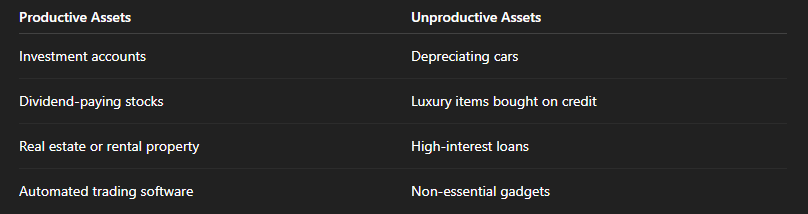
The difference lies in cash flow — productive assets put money in your pocket; liabilities and unproductive assets take it out.
For traders, financial literacy goes beyond charts and technical indicators. It begins with mastering the basics of what you own (assets) and what you owe (liabilities). Maintaining a healthy balance between the two ensures that trading profits contribute to long-term wealth rather than short-term consumption.
As Robert Kiyosaki famously said:
“The rich buy assets. The poor only have expenses. The middle class buys liabilities they think are assets.”
Understanding and applying this principle is the true hallmark of a financially literate trader.