.png)
Financial literacy is one of the most underrated skills in trading. While many traders focus solely on charts, indicators, and market psychology, few take the time to manage their own money effectively. The result? Even profitable traders often struggle to build sustainable wealth. The 50/30/20 Rule, a timeless budgeting framework, can be a simple yet powerful solution when adapted for the trading lifestyle.
Understanding the 50/30/20 Rule
Traditionally, the 50/30/20 principle divides your monthly income into three main categories:
- 50% for needs (essential living expenses such as housing, food, bills)
- 30% for wants (non-essential but desirable expenses such as entertainment, hobbies, travel)
- 20% for savings or investments (emergency funds, retirement, investment portfolios)
This balance ensures financial stability and helps individuals avoid overspending while growing their capital base responsibly.
The Challenge for Traders
For a trader, income is not fixed — it fluctuates based on market performance, risk exposure, and trading frequency. This variability makes traditional budgeting difficult. A trader may earn significantly one month and face a drawdown the next. Therefore, adapting the 50/30/20 rule to the volatile nature of trading income is crucial.
The 50/30/20 Model Adapted for Traders
Here’s how the rule can be refined for professional or aspiring traders:
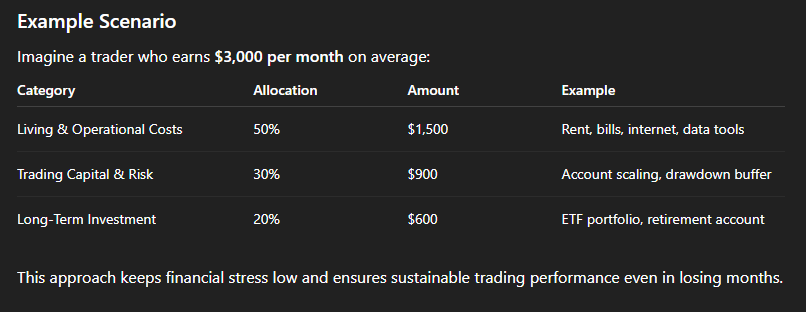
1. 50% – Living and Operational Costs - this portion should cover:
- Rent or mortgage, bills, transportation, and food
- Essential subscriptions (internet, trading platforms, data feeds)
- Health and insurance costs
💡 Tip: Always separate personal living costs from trading expenses. Treat trading as a business.
2. 30% – Trading Capital & Risk Management - this category replaces “wants” with trading capital growth:
- Allocate up to 30% of income to fund or scale trading accounts
- Use part of this fund to backtest, test EAs, or diversify across brokers
- Build a risk buffer (for example, one month’s worth of drawdown protection)
💡 Tip: Avoid adding all trading profits back into the same account. Keep part of it as reserve capital to survive market volatility.
3. 20% – Long-Term Investments & Wealth Growth - this portion focuses on building assets outside of trading, ensuring financial independence regardless of market performance:
- Invest in ETFs, index funds, or dividend-yielding assets
- Build a retirement fund or long-term savings portfolio
- Contribute to passive income streams (real estate, online business, staking, etc.)
💡 Tip: The goal is to turn trading profits into long-term, low-risk wealth.
Key Takeaways
- The adapted 50/30/20 rule gives traders a structured way to manage inconsistent income.
- It separates personal expenses from trading capital, preventing emotional decisions based on short-term results.
- By consistently applying this model, traders can grow wealth both inside and outside of the markets.
Trading success is not only about finding perfect setups — it’s about managing money wisely. The 50/30/20 model for traders introduces financial discipline, builds resilience against income volatility, and supports long-term financial freedom. A disciplined trader isn’t just skilled in markets; they’re also financially literate and strategically stable.